How it works
The graph
Postcode units are the nodes. Edges come from a Delaunay triangulation of the postcode centroids in the ONS Postcode Directory, using OSGB36 eastings and northings — projected coordinates, so Euclidean distance between them is honest and no spherical correction is needed.
Delaunay is the natural "who is my neighbour" relation for irregularly spaced points. Its mean degree is about six regardless of local density, and that density independence is the property everything else rests on: one hop means roughly the same thing in a city as in a glen, even though it means wildly different numbers of metres.
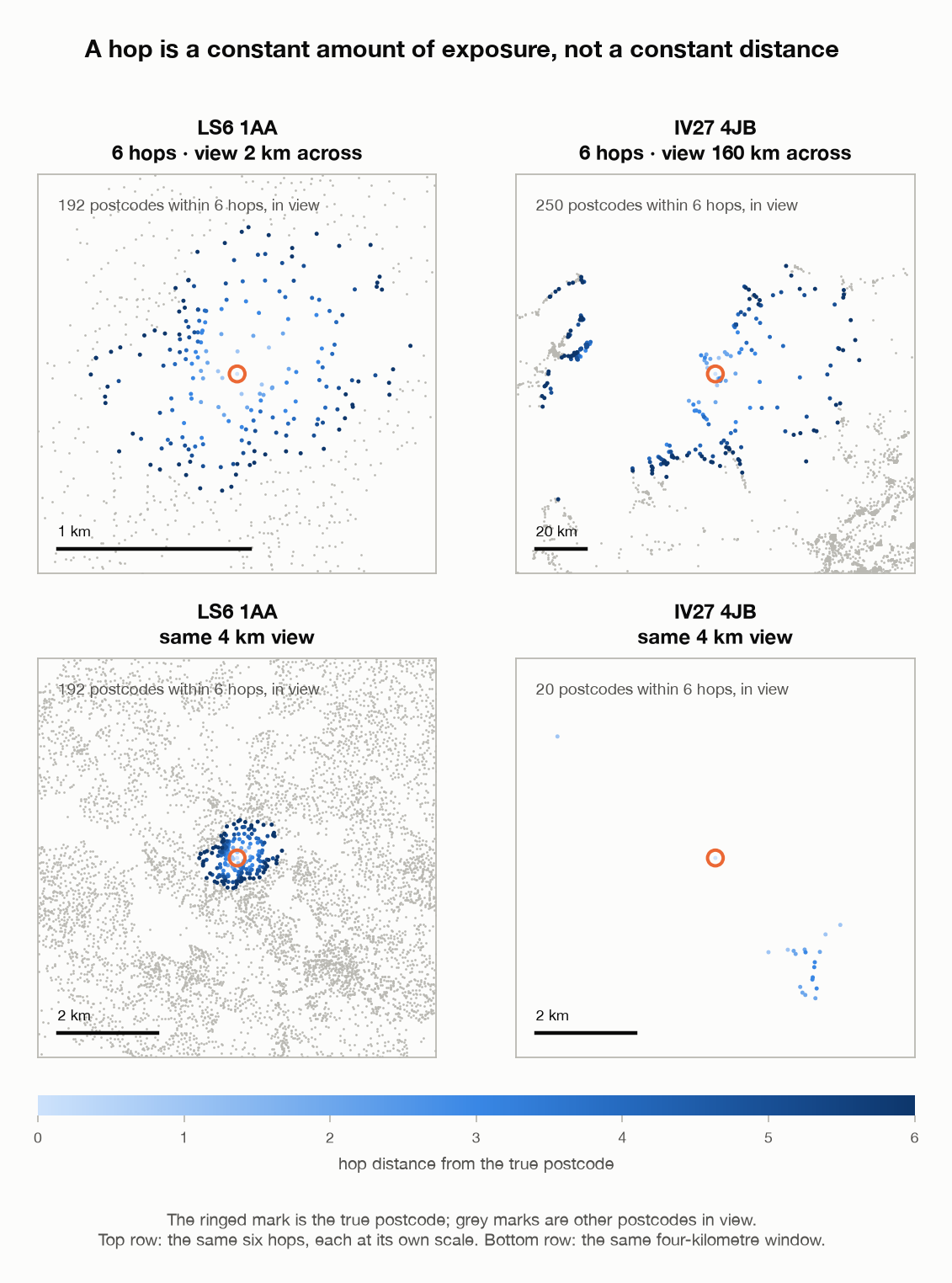
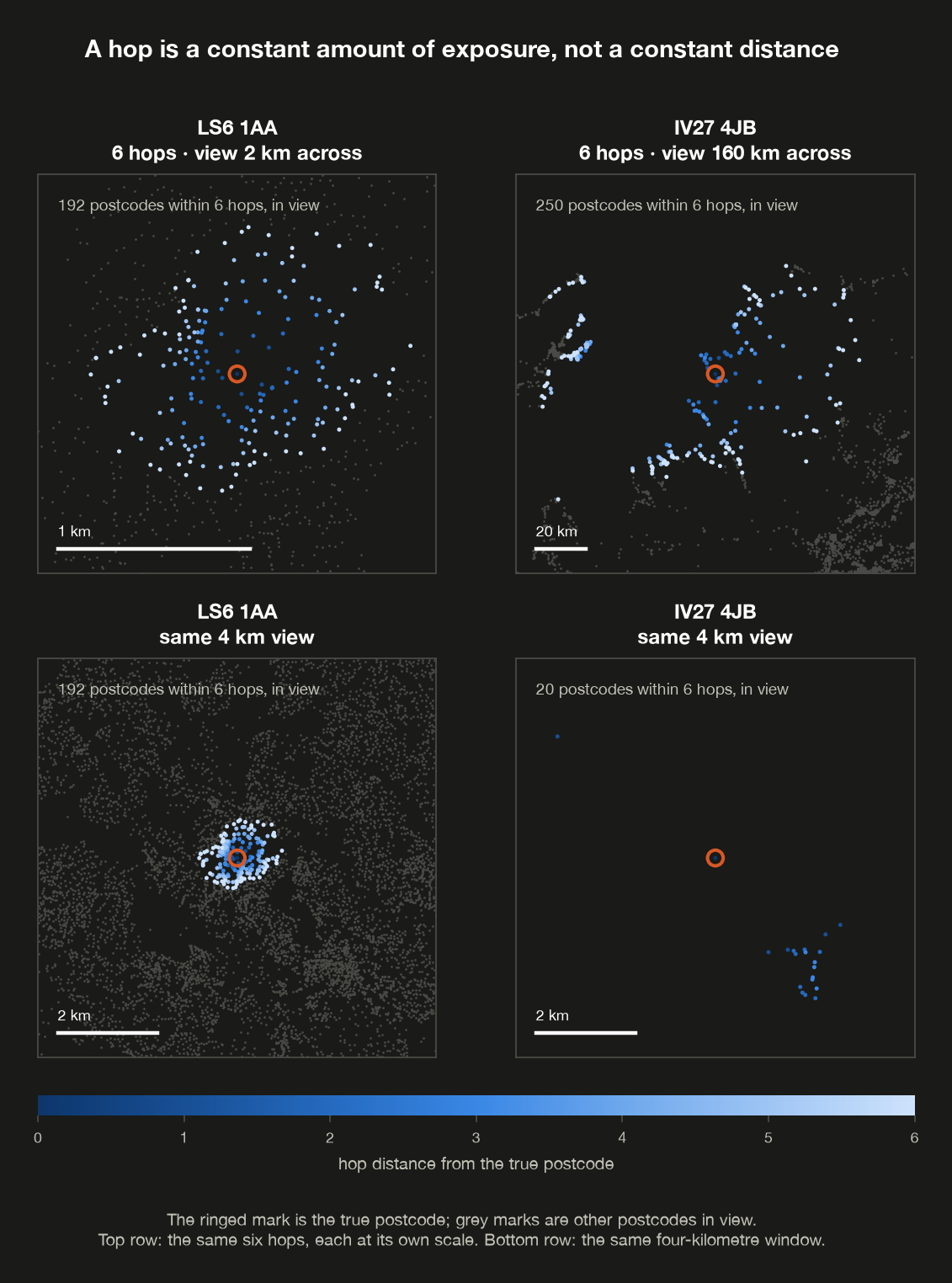
Six hops spans two kilometres in Leeds and a hundred and sixty in Sutherland. The number of people within reach is comparable; the number of metres is not. That is the whole design.
The guarantee
Let \(d(x, y)\) be shortest-path hop distance, and let \(\tilde{d}(x,y) = \min(d(x,y), R)\) for a radius cap \(R\). The mechanism is
where \(\pi(y)\) is the prior weight of postcode \(y\) — residential population by default — and \(Z(x)\) normalises. This satisfies \(\varepsilon\tilde{d}\)-privacy:
The proof is short. \(\tilde{d}\) is a metric, because the truncation \(\min(d, R)\) of a metric is a metric. The triangle inequality gives \(|\tilde{d}(x,y) - \tilde{d}(x',y)| \le \tilde{d}(x,x')\), bounding the numerator ratio by \(e^{\varepsilon \tilde{d}(x,x')/2}\); applying the same bound termwise gives \(Z(x') \le e^{\varepsilon \tilde{d}(x,x')/2} Z(x)\). Multiplying yields the result.
In words: two postcodes \(h\) hops apart produce outputs whose likelihoods differ by at most \(e^{\varepsilon h}\); beyond \(R\) hops the mechanism draws no further distinction.
Why the cap is sound, and the obvious alternative is not
No implementation can evaluate this over 1.7 million nodes without stopping somewhere. The obvious approach — walk out to \(R\) hops and renormalise over that ball — breaks pure differential privacy. A postcode inside \(x\)'s ball but outside \(x'\)'s gets probability zero under \(x'\) and nonzero under \(x\), so the likelihood ratio is unbounded.
Capping the metric rather than the support avoids this entirely. Every postcode in the country keeps nonzero probability: those beyond \(R\) hops all share the floor weight \(e^{-\varepsilon R/2}\), so their total mass is available in closed form as \(e^{-\varepsilon R / 2}\,(\Pi_{\text{total}} - \pi(B_R(x)))\) without enumerating any of them. The result is an exact sample from the exact mechanism — no approximation, no \(\delta\) — at the cost of a breadth-first search over a bounded ball.
The price is a small teleport probability: mass that lands anywhere in the country, drawn from the prior. The library computes and reports it, and chooses \(R\) by default to hold it below \(10^{-6}\). This matters more than it sounds — at \(\varepsilon = 1\) and \(R = 30\) the teleport probability is several percent, which would be a silent utility disaster.
Verified, not asserted
Both claims above are regression tests, not prose. The guarantee is checked by enumerating every \((x, x', y)\) triple on small generated graphs — a proof for each graph rather than evidence about it — and the test is mutation-checked: it catches a missing \(/2\) in the exponent, and it catches support-truncation-instead-of-capping.
Keyed determinism
The uniform that drives the sampler is not random. It is
mapped into \([0, 1)\). The same subject therefore always maps to the same output, with no stored state. Repeated releases leak nothing further, and \(\varepsilon\) is spent once however many times the pipeline runs — which also closes the averaging attack that defeats naive per-call randomisation.
Integer weights
Weights are exact integers and the cumulative distribution is searched in integer arithmetic, for two reasons.
Floating-point leakage. Mironov (CCS 2012) showed that naive floating-point implementations of continuous DP mechanisms leak the true input through the low bits of the IEEE representation. Our mechanism is already discrete over a finite set, so integer weights make it immune by construction rather than defended by patching.
Determinism. The promise that a subject's output never changes would otherwise depend on summation order, NumPy version and platform, and would break silently. Integer weights make it bit-exact — and continuous integration runs the golden tests on both Linux and macOS to prove it.
The one place a real number has to become an integer is the exponential factor \(q^{h}\). Computing each power independently in double precision let the implemented likelihood ratio exceed the advertised bound by around \(10^{-17}\) — negligible in practice, but enough to make the theorem false as written. The powers are now built from an exact rational bound on \(q\), each rounded up from the one before it, which makes the inequality the proof needs hold by construction and puts the error one-sided, on the side that costs utility rather than privacy. The detail is in Methods.